Overlap in Goods and Trade Channels Outweighed by Conceptual Weakness and Design Elements in 2(d) Reversal
EQUIPKEYCO // KEYCO

• Core Issue: The primary issues in this appeal involved a requirement for a disclaimer of the wording "EQUIP KEY CO" based on alleged descriptiveness under Section 2(e)(1) and a likelihood of confusion refusal under Section 2(d) based on a cited registration for the mark "KEYCO" and design.
Background
The Applicant, EquipKeyCo, LLC filed an application, seeking to register its mark EQUIPKEYCO with design on the Principal Register. The goods were identified as "pre-fabricated metal ignition keys for starting heavy equipment, namely construction and agricultural equipment" in International Class 6.
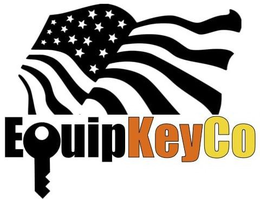
The mark was described as a black and white stylized American flag waving above the words "EQUIPKEYCO." Within the wording, "EQUIP" appeared in black, "KEY" in orange outlined in black, and "CO" in yellow outlined in black. Notably, the letter "Q" was stylized to form a black key.
The Trademark Examining Attorney issued a final refusal on two grounds:
- The Examiner required a disclaimer of the wording "EQUIP KEY CO" under Sections 2(e)(1) and 6(a) of the Trademark Act, asserting the wording was merely descriptive of the Applicant’s goods because the Applicant is an "equipment key company."
- The Examiner refused registration under Section 2(d), citing a likelihood of confusion with Registration No. 3093826 for the mark KEYCO with design.

The Registrant’s goods included "metal, brass and aluminum key blanks; metal and aluminum key chains; metal and brass locks, lock cylinders, pad locks and door locks" in International Class 6.
Disclaimer Requirement
A term is considered merely descriptive under Section 2(e)(1) if it immediately conveys information concerning a feature, quality, or characteristic of the goods. The Board evaluated this "in relation to the particular goods for which registration is sought, the context in which the mark is used, and the possible significance the term would have to the average consumer because of the manner of its use or intended use."
The Examining Attorney supported the descriptiveness argument with extensive evidence, including dictionary definitions establishing that "EQUIP" is a recognized abbreviation for "equipment," "KEY" refers to the literal goods, and "CO" is a standard abbreviation for "company." Furthermore, the Examiner provided several third-party website references showing that "equipment keys" is a recognized category of goods in the industry.
The Applicant argued that "EQUIP" was suggestive because "equipment" is a broad term encompassing many types of machinery, and that the design elements, such as the flag, mitigated any descriptiveness. However, the Board rejected these arguments, stating that descriptiveness is evaluated in relation to the specific goods rather than in the abstract, and that the inclusion of design elements does not relieve an applicant of the duty to disclaim descriptive literal wording within the mark.
Consequently, the Board affirmed the disclaimer requirement while proceeding to the likelihood of confusion analysis.
How the Board Analyzed the DuPont Factors
DuPont #2 Similarity or Dissimilarity and Nature of the Goods
The Board first compared the Applicant’s "pre-fabricated metal ignition keys" for heavy equipment with the Registrant’s "metal, brass and aluminum key blanks; metal and aluminum key chains; metal and brass locks, lock cylinders, pad locks and door locks." The Board emphasized that "compared goods need not be identical or even competitive to find a likelihood of confusion; they need only be related in some manner."
The Examining Attorney provided significant internet evidence demonstrating that the same entities commonly provide both prefabricated metal ignition keys and key blanks under the same mark. The Board also noted that the Applicant’s own specimen of use stated that it provided "32 of our most popular heavy construction equipment keys on 1 ring," indicating a relationship with the Registrant’s "key chains."
The Applicant’s argument that key blanks are different because they must be formed into keys was dismissed. The Board clarified that "the issue, of course, is not whether purchasers would confuse the goods or services, but rather whether there is a likelihood of confusion as to the source thereof." Given the evidence that third parties sell both types of products under the same mark, the Board found this factor favored a likelihood of confusion.
DuPont #3: Similarity or Dissimilarity of Established, Likely-to-Continue Trade Channels
Regarding trade channels, the Board observed that while the Applicant’s ignition keys were limited to heavy equipment, the Registrant’s goods contained no channel of trade or class of purchaser limitations. The Examining Attorney’s evidence included screenshots from websites offering both key blanks and heavy equipment keys on the same webpages.
The Board concluded that "the Internet is a trade channel for such goods." Because the websites cited by the Examiner clearly showcased both types of products in the same virtual marketplace, the trade channels were similar. This overlap in where the goods are marketed and sold supported the Examiner’s initial finding of a likelihood of confusion.
DuPont #4: Conditions of Sale and Purchaser Sophistication
The Applicant argued that its customers, contractors and farmers, are sophisticated because the heavy equipment they operate is expensive. The Board was not persuaded by this logic, pointing out that "Applicant’s goods do not include heavy equipment" itself, but rather relatively inexpensive keys.
The Board examined the price points of the goods in the record, noting that "a key blank can be purchased for as little as $1.02 and machine keys can be purchased for $5.07." The Board remarked that "attorney argument is no substitute for evidence" and that without specific proof of sophistication, the Board could not find that those who operate heavy equipment "take anything but ordinary care, in purchasing low-cost goods." Furthermore, the Applicant made no argument that purchasers of the Registrant’s key chains were sophisticated. Ultimately, the Board found this factor to be neutral in the overall analysis.
DuPont #1: Similarity of the Marks
The analysis of the marks in terms of appearance, sound, connotation, and overall commercial impression became the dispositive factor in the case. The Board reiterated the general rule that the literal portion of a word and design mark is usually accorded greater weight because consumers use the words to call for the goods. However, the Board immediately qualified this by stating that "there is no general rule as to whether letters or designs will dominate in composite marks."
The Board analyzed the conceptual strength of the cited "KEYCO" mark. Using dictionary definitions, the Board found that "KEY" refers to the metal instrument used for locks and "CO" is an abbreviation for company. The Board stated:
"Based on these definitions... we find that consumers of Registrant’s goods would immediately understand the term KEYCO is a combination of the terms KEY and CO, meaning 'key company.' Their understanding is reinforced by Registrant’s design of keys on a key ring. KEYCO therefore has conceptual weakness, and isnot a particularly distinctiveterm for Registrant’s goods."
While the mark was presumed inherently distinctive because it was on the Principal Register without a Section 2(f) claim, the Board characterized it as "highly suggestive of Registrant’s identified goods, and an extremely weak source indicator." The Board then explained that when shared matter is highly suggestive or descriptive, the addition of a term can avoid confusion. The Board observed that "the addition of EQUIP and the design elements of Applicant’s mark are sufficient to distinguish it from the cited mark." Specifically, the American flag design and the "EQUIP" prefix created a distinct commercial impression. The Board concluded that "the DuPont factor regarding the similarity of the marks weighs against a finding of likelihood of confusion" and that this factor was dispositive, outweighing the similarity of the goods and trade channels.
Board’s Decision
The TTAB affirmed the requirement for a disclaimer of the wording "EQUIP KEY CO." but reversed the refusal to register the Applicant’s mark under Section 2(d) of the Trademark Act. The Board held that although the goods and trade channels overlapped, the extreme conceptual weakness of the cited mark meant that the differences in the Applicant’s mark, including the added term "EQUIP" and the prominent flag design, were enough to ensure that confusion among consumers was unlikely.
What I find most interesting reading this case is the conceptual weakness analysis under the first DuPont factor. We are all used to seeing this analysis under the sixth DuPont factor, and not as often under the first.
Under the first DuPont factor, the analysis zeroes in on a structural anatomy of the marks themselves, evaluating their intrinsic appearance, sound, connotation, and overall commercial impression. The goal here is to prove that the shared element between the marks is so highly suggestive or inherently descriptive that it acts as an extremely weak source indicator. The goal is to establish that a term is conceptually weak under this factor that consumers naturally look past that weak element and rely on the other parts of the marks to tell them apart (such as the added word "EQUIP" and the differing design elements in this specific case).
The evidence for this approach is often as simple as pulling standard dictionary definitions to demonstrate conceptual weakness. As in this case, the Board merely used the dictionary to show that "KEY" and "CO" translate instantly to "key company."
In contrast, attacking a mark's weakness under the sixth DuPont factor shifts the focus away from the literal definition and toward the reality of the marketplace and consumers' actual exposure to similar marks. The goal of this crowded field analysis is to prove that the market is so saturated with similar marks that consumers are already conditioned to distinguish between them, giving the cited mark a narrower scope of protection. Typically, third-party registrations are used to show conceptual weakness under this factor, while third-party marketplace use evidence is used to show commercial weakness.